 ☰ ☰
☰ ☰
Altitude Junkies Inc. offer one of the most cost-effective full-service expeditions to Dhaulagiri.
We don't advertise an expedition price and then ask for additional payments at the conclusion of the expedition such as Sherpa summit bonus and kitchen staff gratuities as some of the other operators do. The price you pay the Junkies is the final price.
Our expedition is limited to eight climbers and one expedition leader with a 1:1 Sherpa to climber ratio. Some of the other operators have as many as thirty climbers on one expedition and we feel a smaller team makes for a more intimate and satisfying experience for a climber on Dhaulagiri.
The single leader/expedition manager offers similar expertise as a fully guided climb with a 4:1 climber to guide ratio. Having a 1:1 climbing Sherpa to climber ratio allows each climber a flexible schedule to travel with their own personal Sherpa during acclimatization rotations. Having a personal Sherpa to climb with each member means that climbers are assisted with the carrying of their personal loads if required, therefore reducing their pack weight considerably.
Himalayan veteran expedition organizer Phil Crampton who has multiple summits on Everest and other 8,000-meter peaks will lead the 2026 expedition.
In addition to an experienced leader, the teams head climbing Sherpa Sirdar will be Pasang Nima Sherpa. Pasang has vast experience being a Sirdar on Everest, Lhotse, Dhaulagiri and Manaslu and will be directing our climbing Sherpas who have all summited Everest and other 8,000-meter peaks before, some multiple times.
Our expedition will meet in the capital city of Nepal, Kathmandu where we will stay in the beautiful Hotel Tibet located in a quiet area of the diplomat district of Lazimpat.
After a day in Kathmandu getting to know our fellow team members we fly to Pokhara where we may spend the evening. If the weather is good it may be possible to fly the same day by helicopter to Italian Base Camp where will spend two evenings for acclimatization. We then make the 4-5 hour walk to base camp proper. At the conclusion of the expedition we take a helicopter from base camp to Pokhara where we will board a fixed wing flight to take us back to Kathmandu.
Our base camp is as luxurious, if not more so than some of the other more expensive operators and the food prepared by our highly experienced cooks is considered some of the best available in the Himalayas.
Each climber is provided with a personal Black Diamond 3-person tent at base camp, which is insulated with a foam floor covering and complimented with an extra thick foam mattress.
For group occasions we provide double walled tents for dining. The dining tent has large padded chairs and is spacious, carpeted, heated and lit by solar electricity.
We provide a carpeted and solar-lit toilet and shower tent with toilets, stainless steel wash sinks and hot water heated showers. We make it a policy at Altitude Junkies to remove all human waste from base camp and have porters carry our toilet drums to a lower village where it can be disposed of properly.
The head and assistant cooks have all been trained by western chefs in food preparation and strict hygiene standards and produce a varied and nutritious western menu throughout the expedition. They prepare three delicious hot meals a day as well as preparing an amazing array of appetizers during rest days at base camp.
We use local fresh produce and meats and these are complimented by a huge selection of imported foods and snacks. Our cooks are especially proud of our immaculately clean kitchen, which is fully carpeted to reduce dust underfoot and has all stainless steel countertops for food preparation. The kitchen is complimented with propane barbeque grills and propane ovens they use to bake us all sorts of treats.
We follow a cautious acclimatization schedule at base camp spending two to four nights there before taking our first trip onto the glacier. We plan only to climb on the glacier a maximum of three or four times and this includes the summit push. Our schedule usually sees us make our first climb from base camp to camp one to drop off loads and then returning to base camp the same day.
After more acclimatization and the progress of the fixed ropes being placed up to camp two, we climb to camp one, spending the evening and then explore the route to camp two, spending the evening if possible before returning to base camp the following day. We continue our acclimatization schedule with another night at camp one and camp two before tagging camp three or sleeping there if conditions allow, then descending to base camp.
The summit push will see us make our final climb on the glacier and climb to camp one, two, and three respectively before leaving for the summit from the high camp in early hours of the morning.
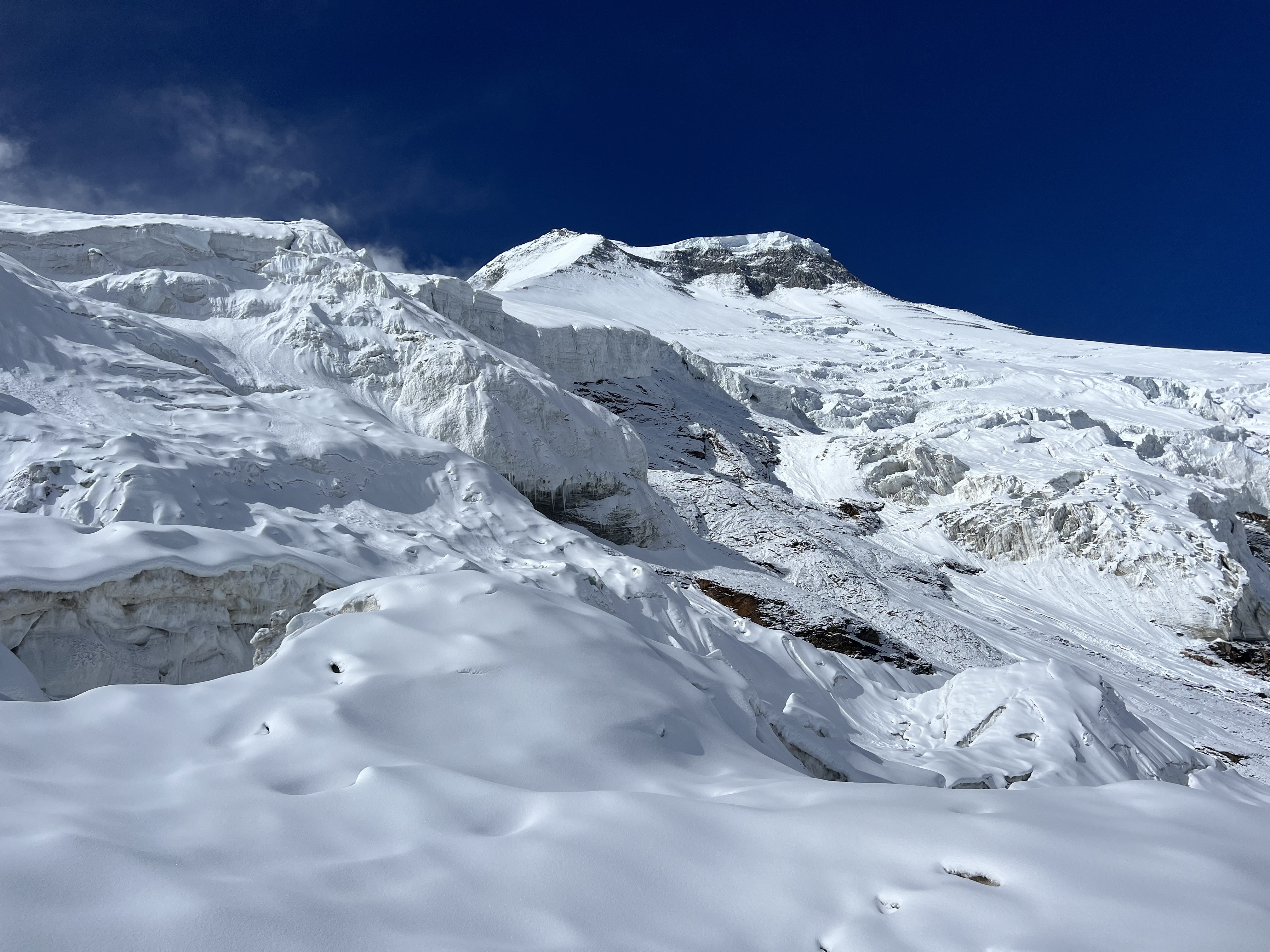
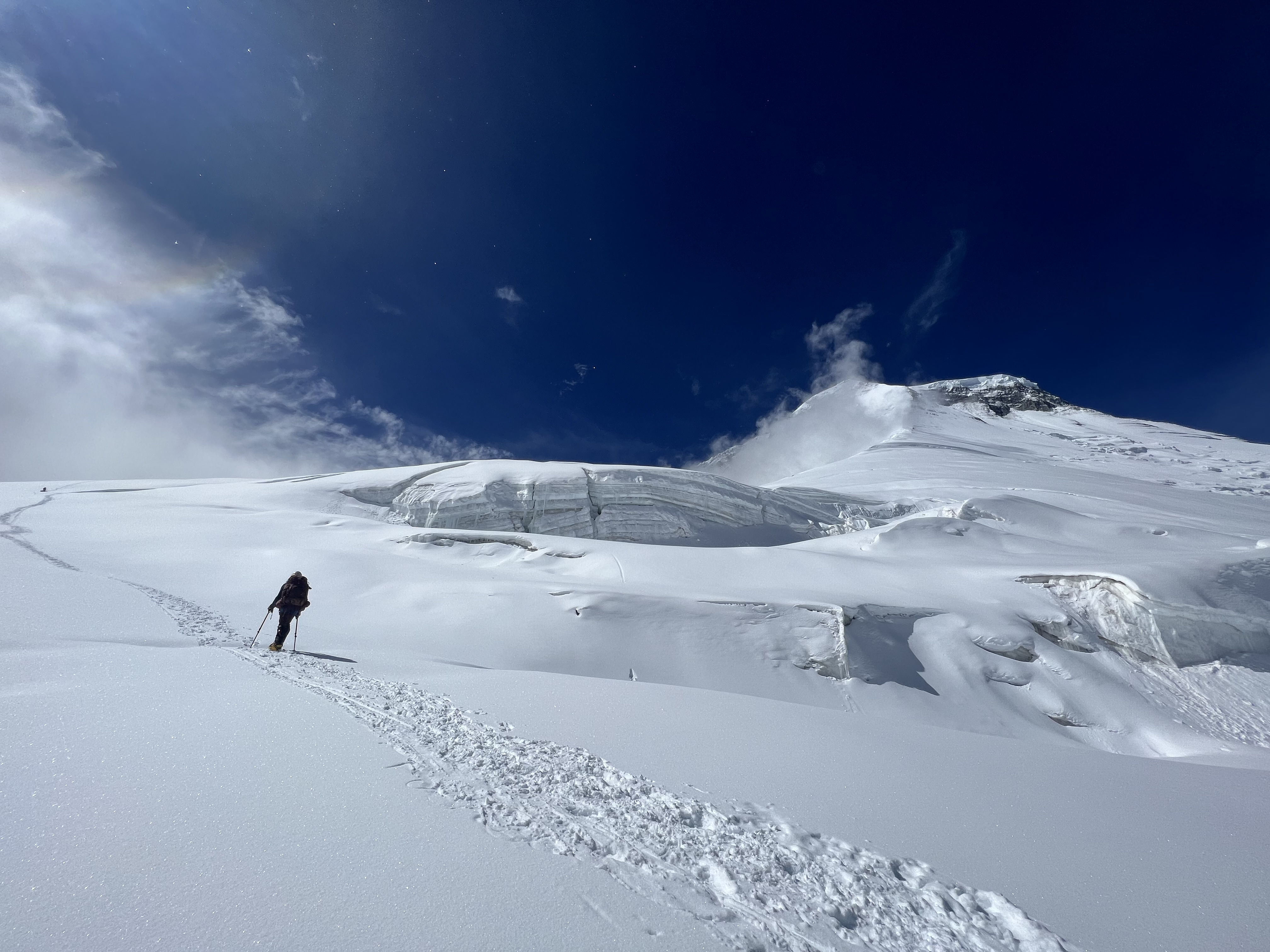
From base camp to camp one the route crosses the glacier towards the base of the North Face, which is referred to as "The Eiger", and below the Dhaulagiri Icefall. The route avoids the steepest part of the icefall by following a steep gully. From the top of the gully, we cross a few avalanche cones to arrive on a plateau and gentler slopes, which then lead to the col.
Camp one sits on this broad col at 5,900 meters. From this camp the route begins to follow the Northeast Spur. The spur is broad and climbed at a reasonably gentle angle to start with and becomes steeper as height is gained.
Camp two is situated on the eastern aspect of the spur at 6,400 meters. The spur above camp two is steeper than the climb to camp two with a few sections up to 45 degrees in angle where it leads us to camp three at 7,400 meters.
Summit day will start late evening or early morning depending on the conditions with climbing on steeper mixed steps which lead to a traverse across a broad, exposed gully. The start of the traverse continues to be rocky and narrow, but widens out into a big gully. On the far side of this gully, the top of a giant hanging serac is gained. From here the angle eases and the next 400 meters is up relatively gentle slopes, following a line just to the right hand side of the ridge. This leads on to 25 degree slopes heading towards the summit rock band. Splitting the rock band is a narrow, 45 degree, 100 meter high couloir, which leads to the summit plateau. Once on the plateau, a short climb to the left over a few steps leads to the summit of Dhaulagiri.
Black Diamond 3-person tents will be used at high camps and these will be occupied by two persons up to the high camp where we usually place three persons per tent for warmth. All food, stoves and cooking gas will be in place and members are only required to carry their personal gear during the expedition.
All climbing members, climbing Sherpas and kitchen staff have unlimited access to doctors from the Himalayan Rescue Association who are stationed at base camp throughout the season. We have our own medical oxygen, portable altitude chambers and comprehensive medical chests at both base and advanced base camps. The higher camps also have medical kits and we also ask that all climbers carry individual micro high altitude medical kits at all times above base camp as the Sherpas and leader does. All climbing members and climbing Sherpas wear a personal avalanche beacon above base camp.
For constant communication we have all climbing members, climbing Sherpas and guides have their own personal two-way radio at all times on the mountain. We also have base station radios at both base and advanced base camp and have these active at all times when members and Sherpas are on the mountain.
Our satellite phones and satellite internet modems are available for our team members to use at base camp at actual cost price as we feel charging an outrageous amount to phone or email family is unfair during such a long expedition.
To ensure the safety of all our climbers we subscribe to a professional weather forecast service for the duration of the season and have access to this information at all the respective base and high camps and receive constant updates during our summit push.
8,000-meter peaks are a serious undertaking and climbers need to be aware there are certain risks that are out of the control of Altitude Junkies. We prefer to describe our Everest expedition as professionally managed rather than guided. A true guided expedition is only where the guides have UIAGM certification, which is the only internationally recognized qualification for mountain guides and there is a 3:1 or smaller guide to climber ratio
Climbers on our Dhaulagiri expedition need to have previously climbed on a 6,000, 7,000 or 8,000-meter Himalayan peak to qualify for our expedition. We do not consider a climb of Aconcagua by its normal route or false traverse as suitable experience to climb Dhaulagiri with the Junkies.
If you need to be guided, look for guides with full Rock, Alpine and Ski UIAGM certification.
Day 1. Kathmandu (Hotel)
Day 2. Fly to Pokhara (Hotel) or heli to Italian Base Camp
Day 3. Helicopter to Italian Base Camp (Camp)
Day 4. Italian Base Camp
Day 5. Trek to Base Camp
Day 6-37. Climbing period
Day 38. Helicopter to Pokhara (Hotel) or fly to Kathmandu
Day 39. Fly to Kathmandu (Hotel)
Day 40. Depart Kathmandu
Climbers are required to have evacuation and medical insurance and we recommend using Global Rescue
Everest, Nepal - 2023
2022
2021
2016
2015
2014
2011
2010
2009
2008
Everest, Tibet - 2018
2013
2012
· Individual accommodation in Kathmandu as itinerary
· Shared accommodation on trek as itinerary
· All meals on trek as itinerary
· Porters for 45kg personal gear to base camp and return
· All meals at base camp
· 1:1 climbing Sherpa to climber ratio
· Group cooks at base camp
· Fixed rope fee
· Expedition permit, peak fee and conservation fees
· Base camp and high camp tents
· Group climbing equipment, stoves and fuel
· Supplementary climbing oxygen (2 bottles), mask and regulator
· Two-way radios
· Medical kits, portable altitude chamber and medical oxygen
· Climbing Sherpa summit bonus and carry bonus
· Kitchen staff tips
· Kathmandu-Pokhara roundtrip flight
· Satellite phone use at cost price
· Airfare to and from Nepal
· Meals and drinks in Kathmandu
· Alcoholic beverages
· Nepal visa costs
· Evacuation costs, medical and rescue insurance
· Personal climbing clothing and equipment
· Personal Puja contribution
Altitude Junkies does not allow any solo climbing above base camp on any of our expeditions.
Contact us: info@altitudejunkies.com